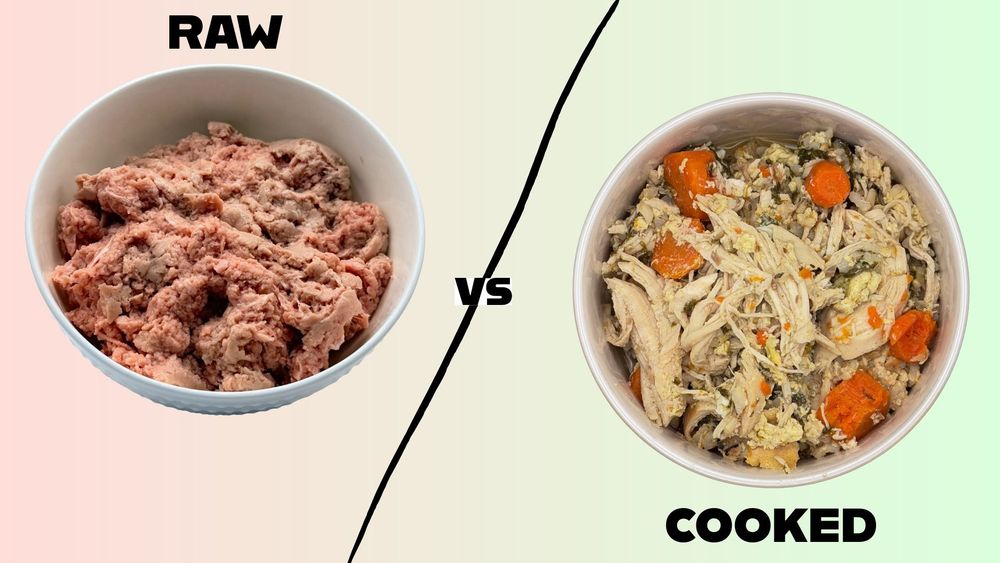
If you've been eyeing raw food because you want something fresher, less processed, and closer to what a dog's body was built for—you're asking the right questions. The concern about ultra-processed kibble is legitimate. So is the risk hiding in raw meat. What most raw-vs.-cooked comparisons skip over is that "raw" is usually a proxy for "fresh," and a well-made cooked meal gets you to the same place without the bacterial lottery that comes with every bag.
No peer-reviewed research shows raw food outperforms high-quality cooked food on any health metric. Dr. Lisa M. Freeman, DVM, PhD, DACVIM (Nutrition), Professor at Tufts Cummings School of Veterinary Medicine, writes in the Journal of the American Veterinary Medical Association that "No scientific studies have shown benefits of raw food diets. Their appeal is based on word of mouth, testimonials, and perceived benefits... these same properties [shiny coat, small stools] can be achieved with commercial cooked diets without the risks of raw meat diets." The benefits owners notice—firmer stools, shinier coat—appear just as reliably on a well-formulated cooked diet.
Raw feeding advocates often reach for the ancestral-diet framing: wolves eat raw, dogs descended from wolves, therefore raw is natural. The problem is arithmetic. Wild wolves live 3–4 years on average. You're feeding a dog you expect to keep for 12–15. Nutrition optimized for short-term survival and nutrition optimized for longevity aren't the same target—and conflating the two is a bit like justifying a diet of beef jerky and river water because your great-great-grandparents made it work.
Bacterial contamination is the main concern, and it's not a fringe risk. An FDA study of 196 raw pet food samples found that roughly 1 in 4—nearly 25%—tested positive for harmful bacteria, including Salmonella and Listeria monocytogenes. That's not an unlucky edge case; that's a predictable failure rate you accept every time you open a bag.
Dr. Renée Reimschuessel, VMD, PhD, researcher at the FDA Center for Veterinary Medicine, noted in the CVM Raw Pet Food Study: "Quite a large percentage of the raw foods for pets we tested were positive for the pathogen Listeria monocytogenes... [this] identified a potential health risk for the pets eating the raw food, and for the owners handling the product."
The exposure doesn't stop at the bowl. Dogs fed raw meat can shed Salmonella in their feces for up to 7 days after a single meal—even without showing any signs of illness themselves. If you have young children, elderly relatives, or anyone immunocompromised in the house, that shedding window isn't theoretical.
Not meaningfully. Most proteins, fats, and minerals in meat are stable under cooking. The vitamins most vulnerable to heat—thiamine (B1) in particular—are easy to supplement in any home-cooked recipe. It's the same principle as pasteurizing milk: the heat step is small, the safety margin is significant, and the nutritional difference is negligible.
High-quality, gently cooked homemade diets produce nearly identical stool quality and nutrient absorption rates to raw diets. Cook chicken to 165°F (74°C) and you've eliminated the bacterial load without meaningfully altering what your dog absorbs from it. You don't have to choose between fresh and safe—that's a false trade-off the raw feeding market has been selling for years.
If you're moving away from raw or commercial kibble, the mechanics are straightforward:
The freshness, ingredient transparency, and bioavailability that drew you toward raw feeding are all still on the table. Cooking just closes the contamination window that raw leaves open.
Fresh beats processed. Cooked beats raw. That's the honest summary of what the research supports.