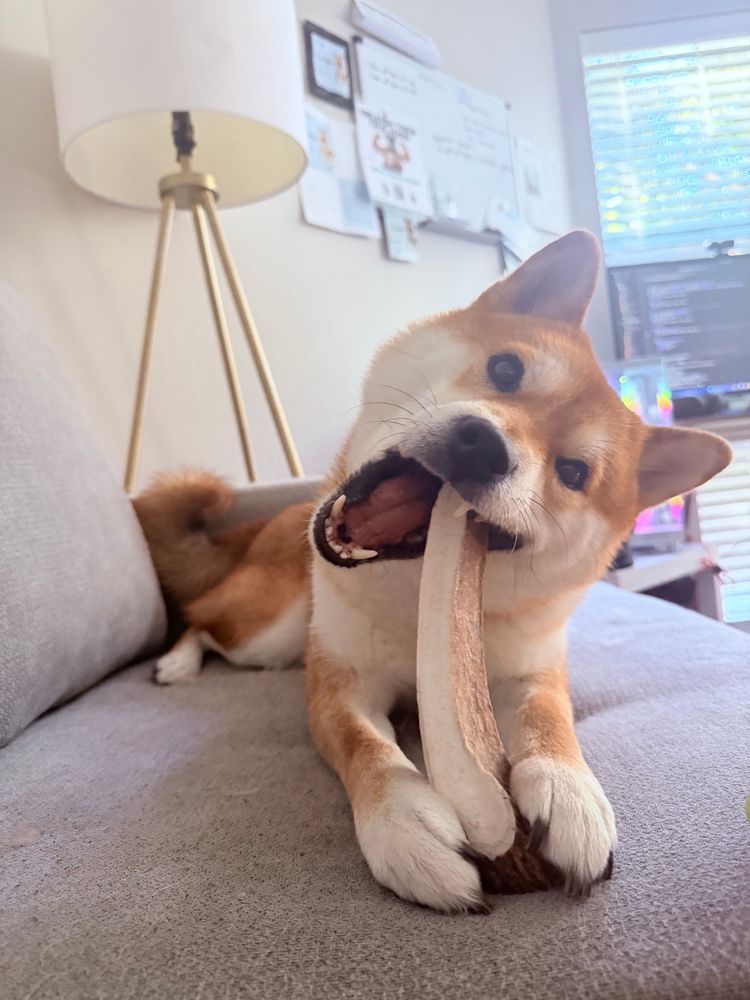
If your dog finds a chew and disappears for twenty minutes, that’s not a problem to solve. That’s biology doing exactly what it’s meant to do. Chewing is a hard-wired need—one that pays off in cleaner teeth, a calmer mind, and a stronger jaw when you meet it with the right outlet.
Yes, but with one important limit. The mechanical action of teeth scraping against a firm surface—like a moose antler or a dense natural chew—physically rubs plaque off enamel before it hardens into tartar. Chewing also triggers saliva production, and saliva carries natural enzymes that neutralize oral bacteria and rinse away food particles. Solid dental maintenance, built into an activity your dog already wants to do.
The limit: chewing can’t reach below the gumline, where the most damaging bacteria accumulate. Think of it as flossing without the dentist—valuable daily upkeep, not a substitute for brushing or annual professional cleaning.
The physical benefits are only half the picture. Chewing releases endorphins and dopamine—the same neurochemicals behind a runner’s high. For your dog, working through a tough chew is genuinely calming, a self-soothing mechanism that brings the nervous system down without any prompting from you.
For high-energy breeds, the payoff is especially clear. A long chew session functions as a focused job—one that burns mental energy as effectively as a training session. A dog who’s spent thirty minutes engaged with a chew is a dog with considerably less bandwidth for chewing your baseboards.
The most common mistake isn’t letting dogs chew. It’s giving the wrong chew for the wrong dog.
Dense, high-mineral natural chews like moose antlers outlast synthetic rubber toys and offer something plastics can’t: genuine textural variety and trace minerals the dog’s body can actually use. That said, a chew that’s too hard for your specific dog can cause slab fractures—a painful crack through the tooth’s outer layer that usually means a vet visit. The thumbnail test is your shortcut: press your nail into the chew, and if it leaves no mark at all, it’s too hard for most dogs. Senior dogs with aging teeth need softer options.
Regular chewing also exercises the masseter muscles—the jaw’s main workhorse. That’s not a minor footnote. Jaw strength declines with disuse, and keeping those muscles engaged through natural chewing helps maintain function well into your dog’s senior years.
Chewing isn’t bad behavior wearing a costume. It’s a biological need that will find an outlet—the only question is whether you choose where. Trying to stop it entirely isn’t realistic, and it isn’t in your dog’s interest. Redirecting to a high-quality natural chew is.
Give them something worth chewing. The rest tends to sort itself out.